


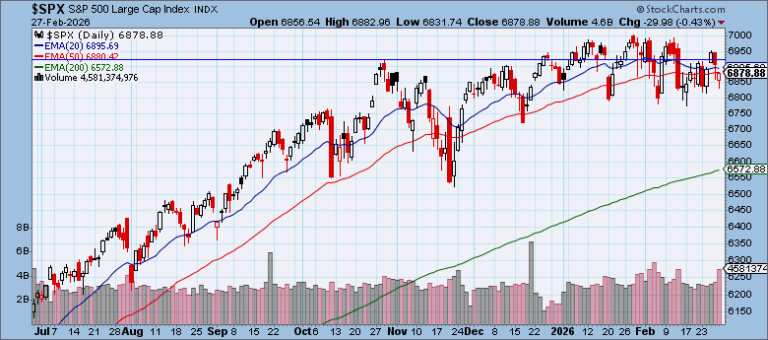
When considering several key aspects of the current U.S. economic and financial market landscape, the word plateau comes to mind. In geology, a plateau is an area of relatively level high ground, as depicted in the picture accompanying this article. In daily life, a plateau is a common, and frustrating, occurrence. After a period of growth or progress, a state of stagnancy sets in with little subsequent advancement. Often despite best efforts to improve. As for the U.S. economy, the inflation rate appears to be at a plateau. As measured by the CPI, the year-over-year rates for both headline and core inflation have gradually declined but have been stuck in the 2% – 3% range for about a year.1 This despite the best efforts of the Federal Reserve to return core inflation to its 2% target. At the most recent FOMC meeting in January, the Federal Reserve held the federal funds rate at 3.50% – 3.75%, citing elevated inflation.2 The federal funds rate may be at a plateau, i.e., maintained at the current level, until the inflation data moves closer to 2%. As of February 27th, there is a 93.6% probability of no change in the federal funds rate at the March FOMC meeting, according to the CME FedWatch Tool.3 As for the financial markets, both the S&P 500 and Nasdaq 100 have plateaued. The S&P 500 and Nasdaq 100 have been roughly flat over the past four months with both indexes below their October 29, 2025 peak.
Reviewing the major U.S. stock market indexes, 2026 is off to a mixed start. Shown below are the year-to-date returns as of February 27, 2026 (price performance, dividends not included).
U.S. Stock Market Index | Year-To-Date Return |
Dow Jones Industrial Average | 1.90% |
Nasdaq Composite | -2.47% |
Nasdaq 100 | -1.15% |
S&P 500 | .49% |
S&P 400 | 8.17% |
S&P 600 | 7.71% |
Shown below is a chart of the S&P 500. The S&P 500 is roughly flat over the past four months and below the October 29, 2025 peak.
Reviewing the S&P 500 sectors via the SPDRs, many sectors are off to a good start in 2026. Technology and Communication Services have been relatively weak on concerns surrounding artificial intelligence (AI) spending. Shown below are the year-to-date returns as of February 27, 2026 (price performance, dividends not included).
S&P 500 Sector SPDR | Year-To-Date Return |
Consumer Discretionary | -2.14% |
Consumer Staples | 15.87% |
Energy | 25.07% |
Financials | -6.10% |
Health Care | 3.49% |
Industrials | 14.20% |
Materials | 17.77% |
Real Estate | 8.65% |
Technology | -3.62% |
Communication Services | .28% |
Utilities | 11.81% |
Having played sports and practiced martial arts for many years, I have hit my fair share of plateaus. To break out of this state, a change in attitude, routine, or environment was required. When thinking about inflation, what is going to be the catalyst that returns core inflation to the Fed’s 2% target? Time? Over some period of time, the core inflation rate will naturally return to 2%? Maybe an economic slowdown? Historically, this has caused inflation to decline. As we stand today, core inflation is elevated and has been at a plateau for about a year. Maybe the Fed’s 2% target is unrealistic? Maybe 3% is a more realistic target given the current environment? In the years following the financial crisis of 2008, the issue was inflation at too low of a level. And this condition persisted for many years. Today, the issue is inflation at too high of a level. And this condition may persist for many years, until a catalyst comes along to alter the environment. As for the federal funds rate, the Fed is getting hesitant to cut the rate any further absent more progress on inflation. The Fed may even raise the federal funds rate should inflation reaccelerate. As measured by GDP, the overall U.S. economy is performing fairly well. The Q1 2026 estimate of real GDP growth provided by the Atlanta Fed (GDPNow) is 3% as of February 27th.4 Given this backdrop, it is not surprising to see an index such as the S&P 500 plateau. In addition, there are other headwinds. For example, the enthusiasm surrounding artificial intelligence (AI) appears to have plateaued. Given the vast sums being spent on AI infrastructure, investors and analysts want to see results. And those results, while positive generally, have been mixed specifically. Critical semiconductor stocks such as Nvidia (NVDA) and Advanced Micro Devices (AMD) have traded sideways for months. This is also true of the Nasdaq 100. Shifting gears to trade, the U.S. Supreme Court struck down President Trump’s tariffs thus injecting more uncertainty into the trade environment. However, international equity markets are performing well in 2026. And lastly, geopolitical concerns are heightened given the situation with Iran. The 7,000 level was a key obstacle for the S&P 500 earlier this year. For the time being, it seems likely that the S&P 500 will continue to trade below this level.
Thanks for reading.
Phillip B. Kaiser, CFA, CFP®, CMT®
Notes
1. U.S. Bureau of Labor Statistics, Consumer Price Index – January 2026. Accessed on Wednesday, February 25, 2026 from https://www.bls.gov/news.release/pdf/cpi.pdf.
2. Board of Governors of the Federal Reserve System, Federal Reserve Press Release – January 28, 2026. Accessed on Wednesday, February 25, 2026 from https://www.federalreserve.gov/monetarypolicy/files/monetary20260128a1.pdf.
3. CME Group, CME FedWatch Tool. Accessed on Friday, February 27, 2026 from https://www.cmegroup.com/markets/interest-rates/cme-fedwatch-tool.html?redirect=/trading/interest-rates/countdown-to-fomc.html.
4. Federal Reserve Bank of Atlanta, GDPNow Model. Accessed on Friday, February 27, 2026 from https://www.atlantafed.org/research-and-data/data/gdpnow.